Quick answer
- Heated room: a compressor dehumidifier is usually the better choice. It removes far more water per day and costs less to run.
- Unheated room that often sits below about 12°C (garage, sleep-out, closed-off spare room, holiday home): consider a desiccant dehumidifier. Its output holds up better in the cold, but it uses more power.
- Capacity labels: most dehumidifiers in Australia and New Zealand are rated at 30°C and 80% RH. Expect much less on a cold winter day.
- What we sell: OurDearHome only sells compressor dehumidifiers. We do not stock desiccant models.
Winter is when most Australians and New Zealanders go looking for a dehumidifier. Windows run with condensation, washing won't dry and the bedroom wardrobe starts to smell musty. The first big decision is the type of machine: compressor (also called refrigerant) or desiccant. The right answer depends less on the brand and more on one question: how warm is the room you want to dry?
How warm is the room you want to dry? That one answer decides the type of dehumidifier more than the brand does.
How each type works
Compressor (refrigerant) dehumidifiers work like a small fridge. A fan draws room air over a cold coil, moisture condenses on the coil and drips into the tank. Consumer NZ notes that refrigerant models use the same technology as heat pumps and fridges.
Desiccant dehumidifiers use a moisture-absorbing material instead of a cold coil. Because they don't need to chill the air, CHOICE says their performance is largely unaffected by the air temperature.
| Compressor (refrigerant) | Desiccant | |
|---|---|---|
| Best in | Heated rooms, warmer months | Cool or unheated rooms |
| Typical rated output | Up to 30L/day or more | Rarely above 10L/day |
| Cold-weather output | Drops as the room cools | Largely unaffected by temperature |
| Running cost | Lower | Can be up to three times higher |
Sources: CHOICE; Consumer NZ (see list below).
What happens when the room gets cold
Cold air holds less moisture, and a compressor has to chill already-cold air to pull water out of it. The independent testers in both countries have measured what this means in practice:
CHOICE (Australia) found that its refrigeration model extracted, on average, more than four times as much water in hot conditions as in cold conditions. By contrast, CHOICE says desiccant performance "should be largely unaffected by the air temperature".
Consumer NZ tests in conditions it expects in Kiwi homes over winter, from 8°C/90% RH to 16°C/65% RH. On average, the dehumidifiers removed less than 30% of their claimed maximum capacity in 24 hours, and results were worse in the 8°C test.
Consumer NZ also says desiccant models typically perform better than refrigerant models below 12°C.
- Mitsubishi Electric New Zealand explains that in low temperatures a compressor dehumidifier must run defrost cycles to keep its coil free of ice, and that it may not be able to remove as much moisture as in warmer air.
None of this means a compressor model is useless in winter. It means the room temperature, not the number on the box, sets how much water you will actually collect.
Which type suits your room in winter.
Running costs and capacity
Desiccant dehumidifiers can cost three times more to run, and use more energy than refrigerant models (Consumer NZ).
Desiccant units rarely exceed a rated 10L per day (CHOICE).
Refrigeration (compressor) models can be rated at 30L per day or more (CHOICE).
So in a room you already heat, a compressor model gets more water out for less power. In a room that stays cold, a desiccant model may be the only type that keeps working well.
Heated room or unheated room?
| Your room in winter | Suggested type | Why |
|---|---|---|
| Living area or bedroom heated by a heat pump, wood burner or heater | Compressor | Higher output, lower running cost |
| Unheated garage, sleep-out, basement, holiday home (often below 12°C) | Desiccant | Works better below 12°C |
Consumer NZ recommends using a dehumidifier together with your heat pump, wood burner or electric heater in the colder months. If you heat the room anyway, a compressor model is the natural partner.
Reading the label: 30°C/80% vs 26.7°C/60%
Dehumidifier capacity is always quoted at a test condition, and different markets use different ones.
- Australia and New Zealand: 30°C and 80% RH. CHOICE says manufacturers' water-removal ratings are typically given at 30°C and 80% RH, and Mitsubishi Electric Australia rates its local models the same way.
- Hong Kong Energy Label: 26.7°C and 60% RH. Hong Kong's energy label is based on the ANSI/AHAM standard test environment of 26.7°C and 60% RH. In a 2023 test of dehumidifiers, Hong Kong's Consumer Council found capacity under the 30°C/80% condition was on average about 70% higher than under 26.7°C/60%.
Our dehumidifiers come from Hong Kong, so the box and the Hong Kong listing show the smaller energy-label figure. It is the same machine. To compare like with like against models sold locally, use the 30°C/80% figure:
| Model | 30°C / 80% RH (AU/NZ basis) | 26.7°C / 60% RH (HK Energy Label) |
|---|---|---|
| Sharp DW-RN23A-W | 23L/day | 13L/day |
| Sharp DW-T30FA | 30L/day | 18.5L/day |
| Sharp DW-T30HA-W | 30L/day | 18.5L/day |
| Mitsubishi BIKUKAN MJ-EH142JV-H | 26L/day | 14.2L/day |
| Mitsubishi BIKUKAN MJ-EH155JV-H | 28L/day | 15.5L/day |
| Mitsubishi BIKUKAN MJ-EHV230JV-H | 38L/day | 23L/day |
Keep in mind that neither condition looks like a New Zealand winter evening. Both are warm, humid test rooms. That is why Consumer NZ's winter results are so far below the label.
The 30°C/80% figure and the Hong Kong Energy Label figure describe the same machine under two different test conditions. Compare the 30°C/80% figure with dehumidifiers sold in Australia and New Zealand.
What size dehumidifier do I need?
Start with the room area. Japanese brands quote a recommended room size based on the JEMA (Japan Electrical Manufacturers' Association) standard — for example, the Sharp DW-RN23A-W is rated for 27–54 m², the Sharp DW-T30FA and DW-T30HA-W for 39–77 m², and the Mitsubishi BIKUKAN MJ-EH142JV-H for 39–59 m² (MJ-EHV230JV-H: 64–96 m²). Because output falls in the cold, choose a size up if the room is only lightly heated or you dry laundry indoors, and check whether the machine supports continuous drainage if you plan to run it all day.
For a fuller walkthrough of capacity choices, see our dehumidifier capacity guide.
Where OurDearHome fits — honestly
We only sell compressor dehumidifiers from Japanese brands. We don't stock desiccant models, so if the room you need to dry is unheated and often below about 12°C, a desiccant dehumidifier from a local retailer is likely to suit you better.
If your home is heated in winter, our range is built for that use:

Sharp DW-T30FA | 3-in-1 HEPA Air Purifier & Dehumidifier
30L/day at 30°C/80% RH, with HEPA and activated carbon filters and Plasmacluster ions; runs from 4°C to 38°C.
View Sharp DW-T30FA
Sharp DW-RN23A-W | Compact Dehumidifier
Compact 23L/day at 30°C/80% RH for bedrooms and studies of 27–54 m², with a direct-drive inverter motor.
View Sharp DW-RN23A-W
Mitsubishi BIKUKAN | Air Purifying Dehumidifier
Made in Japan; 26 / 28 / 38L per day at 30°C/80% RH, with an air purifying filter, activated carbon filter and PM2.5 / PM1.0 display.
View Mitsubishi BIKUKANComparing models? See Best Japanese Dehumidifiers in Australia & New Zealand.
Getting the most from a compressor dehumidifier in winter

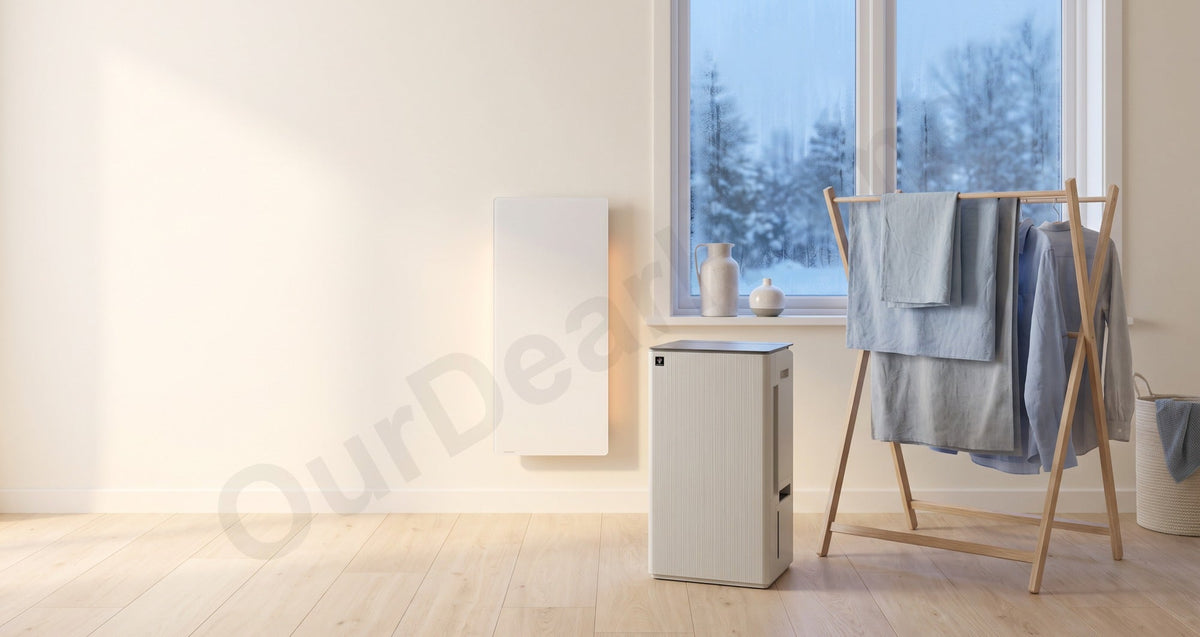
Sharp DW-T30FA with its louvres open — aim the airflow at the drying rack.
- Run it with the heating on. Consumer NZ recommends pairing a dehumidifier with your heat pump, wood burner or electric heater in colder months. For winter laundry drying, Mitsubishi suggests warming the room to about 16°C or more, and notes that laundry takes about twice as long to dry at around 10°C as at 20°C.
- Close the room. Consumer NZ says dehumidifiers work best in the centre of a room with doors and windows shut.
- Set a sensible target. Consumer NZ recommends setting the humidity to 30–50%.
- Dry laundry in a small room. Put the dehumidifier near the drying rack, ideally in a smaller room (Consumer NZ). Our laundry drying guide has more tips.
- Use low-temperature features. Many compressor models defrost automatically in cool conditions. Short pauses in water collection are normal.
Comparing Japanese-brand dehumidifiers for your home?
See capacities at 30°C/80% RH, room sizes and air purifying options side by side.
Browse DehumidifiersFAQ
Q: Is a desiccant or compressor dehumidifier better for winter?
A: It depends on the room temperature. In a heated room, a compressor dehumidifier usually removes more water for less power. In an unheated room that often sits below about 12°C, a desiccant model tends to perform better, although Consumer NZ says it can cost up to three times more to run.
Q: Why does my dehumidifier collect less water than the label says?
A: Ratings are measured in warm, humid test rooms — usually 30°C and 80% RH in Australia and New Zealand. In Consumer NZ's winter-condition tests (8–16°C), dehumidifiers removed less than 30% of their claimed capacity on average.
Q: Why does your listing show 13L or 18.5L when the product title says 23L or 30L?
A: The smaller figure is the Hong Kong Energy Label rating, measured at 26.7°C and 60% RH. The larger figure is measured at 30°C and 80% RH, the basis most Australian and New Zealand listings use. Both describe the same machine.
Q: What size dehumidifier do I need for a 3-bedroom house?
A: Most homes are better served by one machine per zone than one machine for the whole house. Use the manufacturer's recommended room area for the space you'll use it in — for example 39–77 m² for the Sharp DW-T30FA — and size up if the room is only lightly heated in winter.
Q: Do you sell desiccant dehumidifiers?
A: No. OurDearHome currently sells compressor dehumidifiers only. If you need to dry a cold, unheated space, a desiccant model from a local retailer may suit you better.